Solutions · Business Services
Internal Carbon Pricing
helping to drive carbon reduction within your business

helping to drive carbon reduction within your business
Larger companies are effectively taxing individual departments or branches, based on their emissions. Following a carbon footprint assessment smaller businesses are ring fencing funds based on their emissions. This money can then be put aside for internal carbon reduction investments and supporting external projects too.
The UN Global Compact is encouraging organisations to set an internal price on carbon at 100 USD per tonne of CO2e by the year 2020.
Different companies may select a level that works for them. It is important that a level is set high enough to lead to meaningful changes. We suggest starting by setting a price of £20-25 per tonne of CO2, as this typically relates to 1-6% of the cost of causing emissions (as shown in the table below).
|
Electricity |
Natural Gas |
Car miles |
Flights |
|
| 1 tCO2 is equivalent to | 2400 kWh | 5500 kWh | 3300 miles | 5200 km |
| Cost to produce 1 tCO2 | £335 | £220 | £1485* | £400 |
| £20 carbon tax represents | 6% | 9% | 1% | 5% |
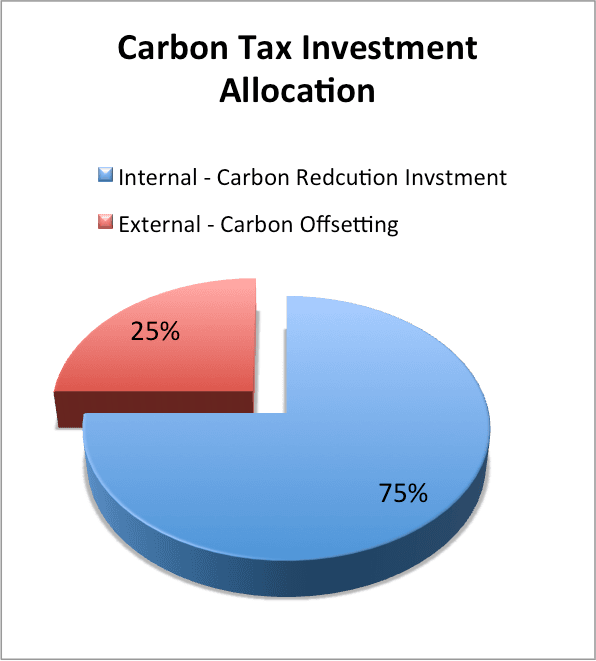
The fund collected through this pricing mechanism can be reinvested across internal and external activities. We recommend a strategy is set to invest 75% on internal carbon reduction measures and 25% on external carbon offsetting activities.
Investments in internal carbon reduction activities should be made based on the level of carbon savings and the associated cost savings. Good carbon reduction investments usually pay for themselves and give a return on investment to the business within 3 years.
Once a carbon price has been set, the money allocated can be used to fund emission saving opportunities and to offset emissions. Carbon Offsetting is a vital tool for organisations looking to become carbon neutral. More information about carbon offsetting can be found here.
A growing number of business leaders recognise carbon pricing as the most efficient and cost effective means of reducing emissions, and they are publicly supporting it.
Microsoft placed a cost on carbon and report savings of $10million per year

Company A is a large organisation, engaged largely in office admin activities, that uses 1,200,000kWh of electricity (approx. £120k spend per year) and 200,000kWh of gas annually (approx. £8k spend). In addition, they own 20 petrol company cars with a total annual mileage of 200,000 miles.
Our consultants help organisations of every size measure, reduce and credibly communicate their carbon footprint.